Flashes of Intuition
No one knows where ideas come from. Let’s talk about it anyway.

John Conway was a mathematician who resembled Jack Nicholson from The Departed. He passed away just a few years ago but left an impressive legacy by making significant contributions to various fields of math including group theory and knot theory. He’s most proud of developing a system of numbers that includes real numbers and extends the reals to include infinite numbers which he called surreal numbers. In 1970, he also invented a game called Conway’s Game of Life. Want to play?
Okay fine, it’s not really a game in the traditional sense because it has zero players. But I’ll still tell you the rules of the game. Remember those composition notebooks from middle school that everyone begged their mom to buy every September? Imagine the version with the grid squares in the pages, and imagine that each cell can be in one of two states: alive or dead.

Conway found that a pattern emerges over discrete time steps according to very simple rules:
1. Any live cell with exactly 2 or 3 live neighbors remains alive.
2. Any live cell with fewer than 2 neighbors dies (loneliness, of course).
3. Any live cell with more than 3 neighbors dies (proof that living in Manhattan, forever is not sustainable).
4. Any dead cell with exactly 3 neighbors becomes alive.
The starting point defines the outcome of this game, and despite these simple rules, it produces shockingly surprising results. Emergent complexity reigns in Conway’s game as highly intricate structures spontaneously emerge. The game self-organizes to produce patterns that appear and disappear.


Some well-known patterns that emerge include still-life (stable shapes that don’t change over generations), oscillators that cycle through states repeatedly, and spaceships that seem to glide across the grid.
When asked why or how he came up with his game, Conway famously said the idea, like most of his mathematical insights, “appeared to [him] in a cloud” after “popping into his head.” One of the most acclaimed mathematicians of our century attributes his ideas to glimmering glimpses of whimsy.
Okay, maybe not the most helpful genius to learn from in order to develop intuitive insightful moments in ourselves. So let’s talk about Srinivasa Ramanujan.
Ramanujan grew up in southern India, formally uneducated and barely able to afford food. At the age of 24, he began to send a series of letters to prominent mathematicians with some of his thoughts along with a disclaimer that he “has not trodden through the conventional regular course which is followed in a university, but is striking out a new path for himself.” One recipient, a mathematical giant in his own right, began a correspondence and arranged for Ramanujan to come to England to work on mathematics ‘properly’. Only eight years later in 1920, he tragically died, but not before he left thousands of elegant proofs.
Ramanujan said his statement of partition identities—equations about the different ways you can break a whole number up into smaller parts (such as 7 = 5 + 1 + 1)—came to him in a dream. He was fond of saying that his equations had “been bestowed on him by the gods.” More than 100 years later, our best mathematicians are still trying to catch up on Ramanujan’s visions and they keep popping up in every corner of the world of math. Just last year, a mathematician studying special points, called singularities, where curves cross themselves unexpectedly found a way to prove their deep underlying structure using statements written from Ramanujan a century earlier.
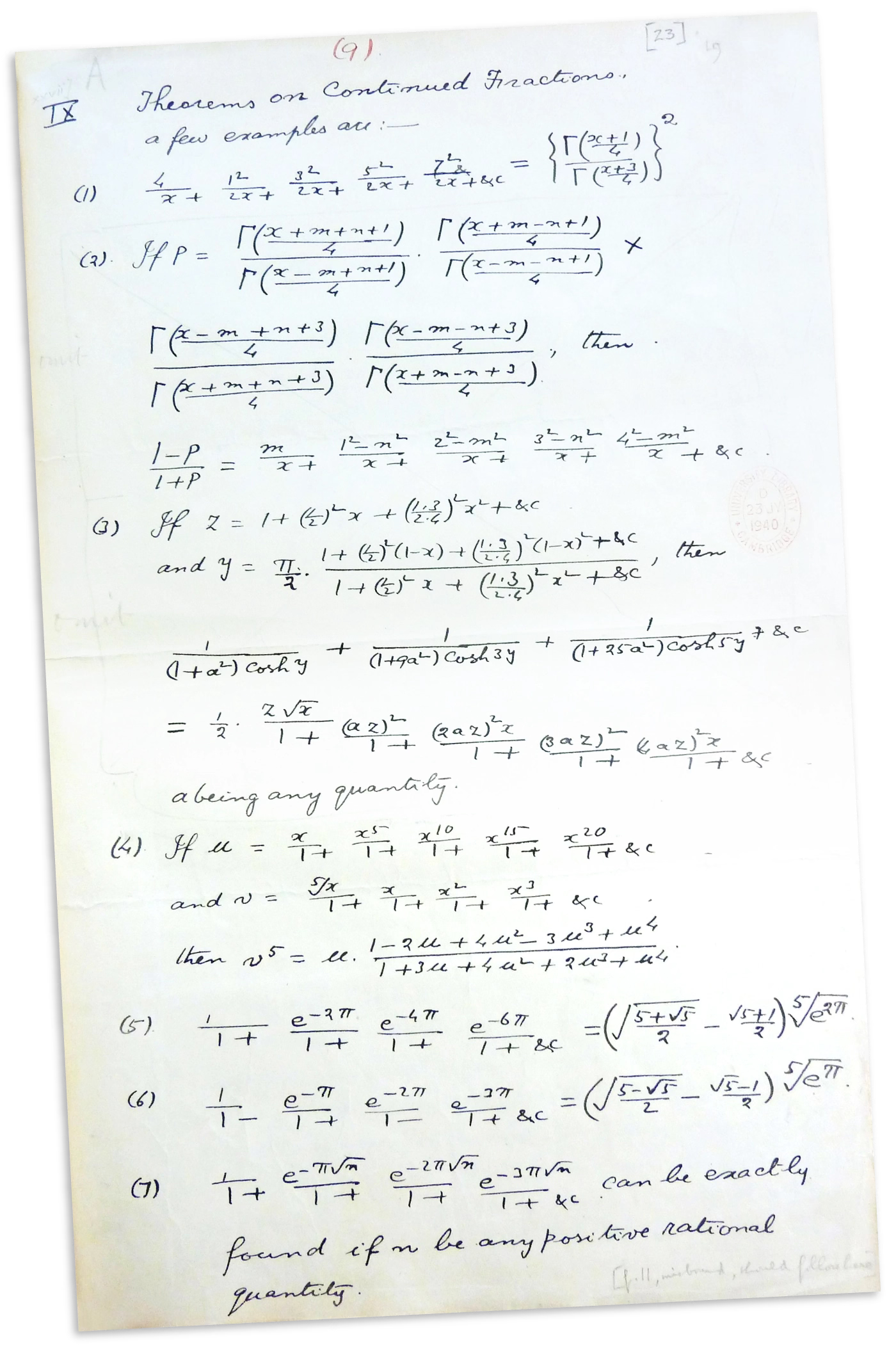
Ramanujan brings to life the myth of the self-taught genius. He’s also not the most helpful guide for someone like me, longing to create something lasting.
Let’s turn our attention to a mathematical juggernaut slightly less neurodivergent as our last example: Dr. Paul Erdős.
This man is so prolific in the world of mathematics, there is a number named after him. Erdős number describes a person’s degree of separation from Erdős himself, based on their collaboration together. An Erdős number of 1 means you have collaborated immediately with him, while 3 would be a collaborator of a collaborator of a collaborator. It’s estimated that 90% of the math world has an Erdős number less than 8. Do your best to imagine publishing 1,500 papers in a technical field. The folklore around him says that he would show up at a math department doorstep and announce, “my brain is open”, brilliantly come up with some deep intuitions, and move on the next college campus.
During an episode of depression after his mother died, a friend of Erdős bet him $500 that he could go one month without taking the amphetamines he had become dependent on (no one knows how long he had been taking amphetamines before this). He won the bet, then promptly returned to taking speed saying, “I’d get up in the morning and stare at a blank piece of paper. I’d have no ideas, just like an ordinary person.”
I set out to write this piece as a way to figure out if we can learn anything from these strokes of genius by studying how their brilliance came to them. What’s in the mysterious cloud of insight? What is behind these intuitions? Can we manufacture them or is it left to the fates? These intuitive or visionary experiences are fascinating, complex, religious.
Truthfully, the answer is cloaked in mystery and spiritual truth and myth. I should leave it at that.
But allow the curiosity in me to entertain a few alternative, albeit partial, explanations.
Conway was known to meet his students in pleasant surroundings in the various gardens and parks near the University of Cambridge. He would work out solutions with students by grabbing scraps of paper and start scribbling. After a series of false starts, re-statements of the problem, and linkages to other branches of mathematics, the discussion would usually come to some conclusion and he would continue walking slowly in the park, leaving behind the scraps of paper.
Ramanujan, despite his poverty, devoured all the advances textbooks he could get his hands on. His thought was if he could ignore all other subjects and read enough mathematics, numerical properties and patterns would begin to reveal themselves.
Erdős willingly lowered himself from his high perch in the world of mathematics to make his work a social activity. He humbly understood the limits of his thinking, shed his person views on how things should be done, and saw the field as inherently collaborative to solve open problems.
Yes, there is definitely unreplicable brilliance in the world. The biological soupy stuff that makes us different and unique and look at the same painting and illicit totally different interpretations. Genius, no doubt, is biologically forward. I also believe that many intuitive breakthroughs happen when the mind synthesizes vast amounts of information unconsciously. Those restful daydreaming states that feel like rocking in a hammock or walks where you have no memory of getting from your doorstep to the path by the river. It seems that during those moments we are drawing from a different realm, a collective of ideas. Receiving these thoughts.
We can take a step towards having our own intuitive revelations by deep immersion followed by incubation. Create the dots in your mind (this part is hard, hard work), and then create conditions for insight to happen through a restful environment and meditative curiosity.
This happens in your own life everyday on a mundane scale, just without the grandeur of something crazy like progressing an entire field. You have hunches. You can’t explain why a certain path is the right way but you know it is the right way. I’m here to validate that intuition on one condition: you having already done the really hard work that is knowing yourself deeply. With that condition satisfied, you don’t need to be able to know why you know, as long as you know.